The Albert Chain: A Buyer's Guide to Antique Gold Watch Chains
What to look for, what the hallmarks tell you, and how to wear one today
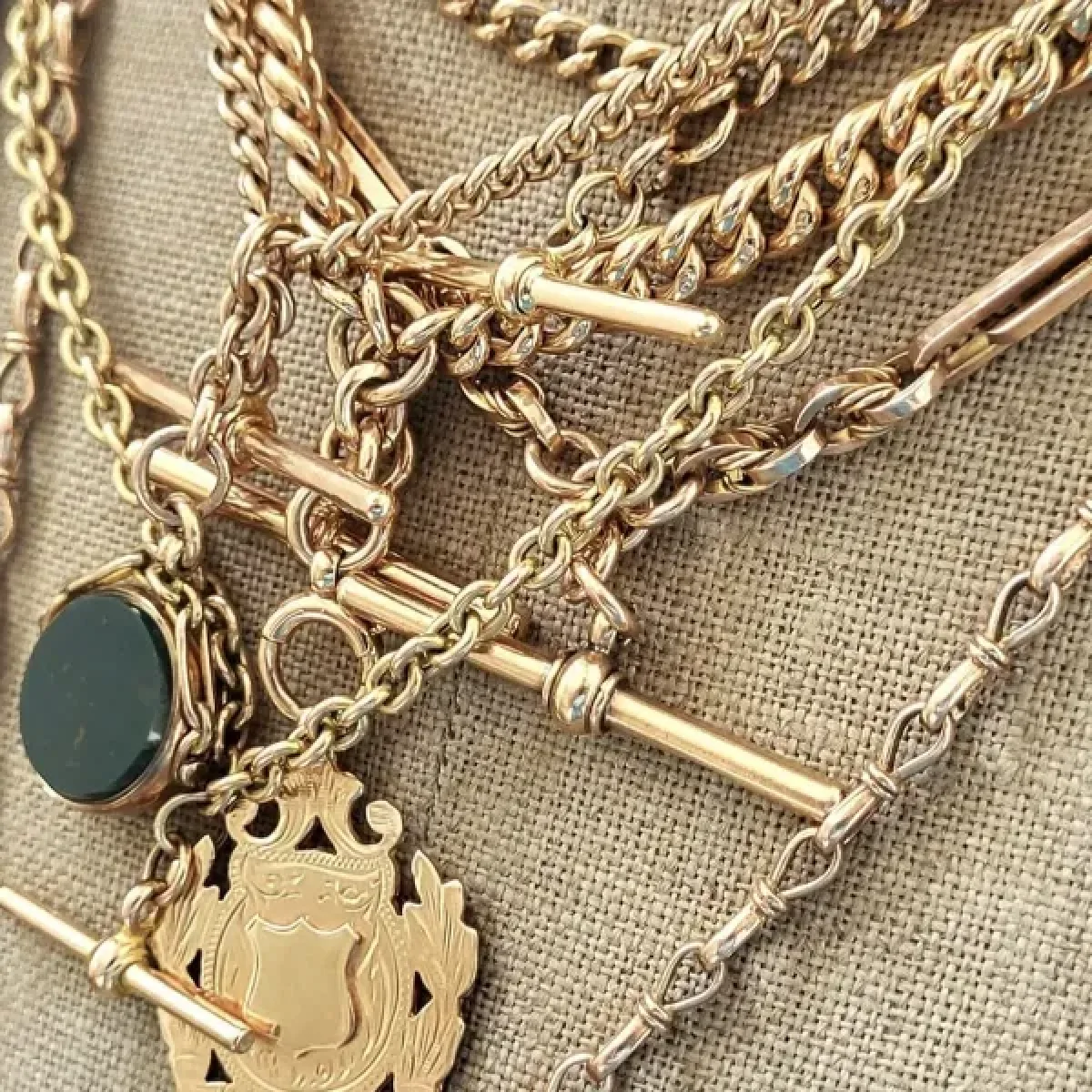
If there's one thing that gets us excited when it comes through the door at De Bruns, it's a good Albert chain. The weight of it in your hand, the soft run of the links through your fingers, the little T-bar and swivel that were put there for a reason well over a hundred years ago. These chains were made to hold a gentleman's pocket watch across his waistcoat. Today they're some of the most wearable antique jewellery there is, and we never tire of handling them.
We've put this guide together from the questions we're asked most often, and from what we look at ourselves when deciding whether a chain earns its place in our antique Albert chain collection. Whether you're buying for yourself or for someone special this Christmas, we hope it helps you choose with confidence.
What is an Albert chain?
Put simply, it's a watch chain. The name goes back to Prince Albert (1819-1861), Queen Victoria's husband, who is said to have worn one in this style, and once the fashion took hold it lasted the best part of a century. The chain ran across the front of the waistcoat. A T-bar at one end passed through a buttonhole to hold everything in place, and a swivel clasp at the other end held the watch, which sat snugly in a waistcoat pocket. Many chains also have a short drop hanging from the T-bar, there to carry a fob, a seal or a medal where it could be seen.
You'll also come across the double Albert, with two lengths of chain running out to a pocket on either side and the T-bar fixed in the middle. They're less common, and a good one never stays with us for long.
The parts of an Albert chain
Once you know the parts, every listing makes a lot more sense.
The T-bar is the small crossbar that once slotted through the buttonhole. Worn as a necklace it hangs at the front like a little pendant, and on plenty of chains it slides along the links or comes off altogether, so you can go for a cleaner look whenever you like.
The swivel, sometimes called a dog clip, is the sprung clasp that held the watch. Now it fastens the chain, and it's also the natural place to hang a fob, locket or medal. Some chains have one at each end.
Lighter chains sometimes finish with a small round bolt ring instead. And then there are the links, which is where each chain's personality comes through.
Link styles
Most of the Alberts we see have curb links. Each link is twisted and flattened so the chain lies flat, which made perfect sense against the cloth of a waistcoat and looks just as good against skin today.
Belcher links are round and a little more open, so the chain looks lighter. Trombone links are long ovals with short connectors in between, and they give a lovely rhythm along the length. Fetter chains alternate one long link with a cluster of small round ones, often described as "fetter and three". Now and then a chain mixes styles, trombone with twisted links for example, and those are always a treat to find.
Then there are graduated chains, which are a bit of a weakness of ours. The links change size gradually along the length, so the chain has real weight and movement when it's on. The finest we've had in recently was an 18ct chain of almost seventy grams, and you could feel the difference the moment you picked it up. Chains like that don't come along often.
9ct, 15ct or 18ct? What the gold tells you
The carat tells you how much gold is in a chain, but on an antique British piece it can also help you date it, which is one of the things we love most about them. Until 1854, gold could only be hallmarked at 22ct or 18ct. That year three lower standards arrived: 9ct, 12ct and 15ct. Then in 1932, 12ct and 15ct were dropped and 14ct came in to replace them.
| Carat | Mark | Gold content | Good to know |
|---|---|---|---|
| 9ct | 9 / 375 | 37.5% | The carat we see most often on Alberts. Durable, and still a legal standard today. |
| 12ct | 12 / 500 | 50% | Only hallmarked between 1854 and 1932, and we rarely come across it. |
| 15ct | 15 / 625 | 62.5% | Also only hallmarked between 1854 and 1932, so a hallmarked 15ct chain was made before 1932. A rich, warm colour. |
| 18ct | 18 / 750 | 75% | The deepest colour and the most gold of the four. |
You'll notice plenty of rose gold among antique Alberts too, and a lot of the chains that pass through our hands are 9ct rose. That soft pink warmth comes from extra copper in the alloy, and in person it's gorgeous.
Reading the hallmarks
On a well-made Albert you'll often find marks in more than one place: on the swivel, on the T-bar, and sometimes on the individual links. A stamp on the links is always a good sign. A full British hallmark has the maker's (or sponsor's) mark, the carat mark, the assay office mark and, on older pieces, a date letter for the year it was tested.
The assay office mark tells you where the gold was tested. These are the ones you're most likely to find on an antique chain:
- An anchor for Birmingham. The city was the centre of the British jewellery trade, so this is the mark we see most.
- A leopard's head for London.
- Three wheatsheaves and a sword for Chester. The office closed in 1962, and collectors have a real soft spot for it.
- A rose for Sheffield, and a castle for Edinburgh.
- Hibernia, the seated figure with a harp, for gold assayed here in Dublin. We always get a little thrill when we find one.
Not every antique chain is fully marked. Earlier pieces and imported ones sometimes carry only part of a hallmark, or none at all. That's why every Albert we list states its carat and its weight in grams, so you always know exactly what you're buying.
Solid or hollow?
Victorian makers made both, and both have their place. A solid chain is heavier, feels substantial and copes happily with being worn every day. A hollow chain gives you the same generous look with less gold in it, so it's lighter on the neck and gentler on the budget. The thing to watch on a hollow chain is dents, because a dented hollow link is very hard to put right, so have a close look at the photographs. If a listing doesn't say which it is, just ask and we'll tell you.
Length: finding the right fit
Alberts were made to stretch across a waistcoat, not to sit at a standard necklace length, so they vary far more than a modern chain. Ours usually run somewhere between 15 and 27 inches. As a rough guide:
- 16 to 18 inches sits close at the base of the neck. A great everyday length, and the T-bar looks lovely at the front.
- 18 to 20 inches falls to around the collarbone, just right if you want to hang a fob or medal from the swivel.
- 22 inches and over drops to the chest, and can be doubled for a layered look.
Every Albert on our site has a key details table giving its length, link type and T-bar length, so it's easy to compare chains side by side. The shorter ones make wonderful bracelets, too. Have a look at our antique Albert bracelets.
Condition: what to check
A chain that spent a century on a waistcoat will show a little wear, and that's to be expected. What matters is that it's sound. Wherever you buy, these are the things worth checking:
- The links. Look for links worn thin where they rub together, especially near the swivel.
- The swivel. It should open smoothly and close with a firm snap.
- The T-bar. Check the small ring that joins it to the chain.
- Repairs. A replaced link or a solder join isn't a reason to walk away, but it should always be mentioned in the description.
How to wear an Albert chain today
This is the part we love talking about, because there's no wrong answer. Wear it as a necklace with the T-bar hanging at the front, or take the T-bar off for a cleaner line. Clip a fob, a locket or one of our antique gold medals onto the swivel and it becomes a piece that's completely yours. Our gold charms work beautifully too. A longer chain can be doubled, or layered with others for real impact.
The original way still looks wonderful, of course. An Albert across a waistcoat is a lovely finishing touch at a wedding or any formal occasion. Browse our gentlemen's wear for pieces in the same spirit.
An Albert chain as a gift
We'd happily say an Albert is one of the best gifts in the shop. It suits her as well as it suits him, it carries more than a century of history, and it simply doesn't go out of style. If you're buying for Christmas, our layaway plan lets you spread the cost, and if you'd rather they picked their own, a De Bruns gift certificate lets them do exactly that.
Questions? Talk to us
If you'd like a hand finding the right chain, send me a message on WhatsApp. Tell me the length you have in mind, your budget and who it's for, and I'll come back to you with a few chains that fit. Or if you'd rather browse, the full Albert chain collection is waiting for you.