Antique Gold Medals: From Victorian Prize Medals to Modern-Day Pendants
From Victorian prize medals to beautifully engraved Edwardian examples, discover the craftsmanship, history and individuality behind antique gold medals, and why we love wearing them today.
Antique Gold Medals: History You Can Wear
There is something about an antique medal that immediately makes you want to turn it over in your hand.
Who received it? What was it awarded for? Why was that particular date engraved? Who made it? And how has something created more than a century ago survived to reach us today?
This is exactly what we love about them.
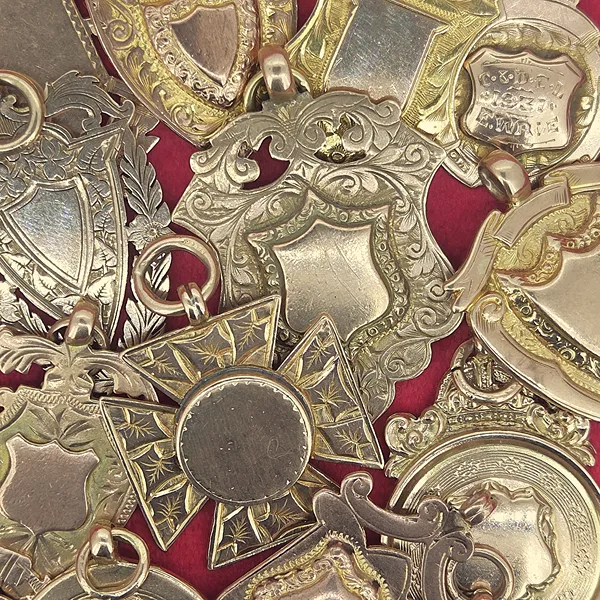
Our newly curated collection of Antique Gold Medals brings together pieces dating predominantly from the late 19th and early 20th Centuries, including Victorian and Edwardian examples alongside slightly later pieces. The collection encompasses prize, presentation and commemorative medals, selected for their quality, condition and character.
These are objects that sit somewhere fascinating between history and fine jewellery.
They were created to mean something. They were awarded, presented, engraved, worn and kept, and unlike a piece of jewellery created purely for decoration, an Antique Medal can preserve remarkably specific clues to its first life names, initials, dates, makers' marks and hallmarks.
Today, we think they deserve to be worn all over again.
When suspended from one of our Antique Albert chains, added to a collection of fobs or worn alone as a pendant, an old gold medal becomes something unexpectedly contemporary.
And no two are quite the same.
What Exactly Is an Antique Gold Medal?
When we talk about antique medals, we aren't referring solely to military medals.
During the Victorian, Edwardian and early 20th-Century periods, medals were produced for an enormous variety of reasons. They could recognise achievement, commemorate an event, mark membership of an organisation or be presented as prizes.
This explains the extraordinary variety of designs that survive.
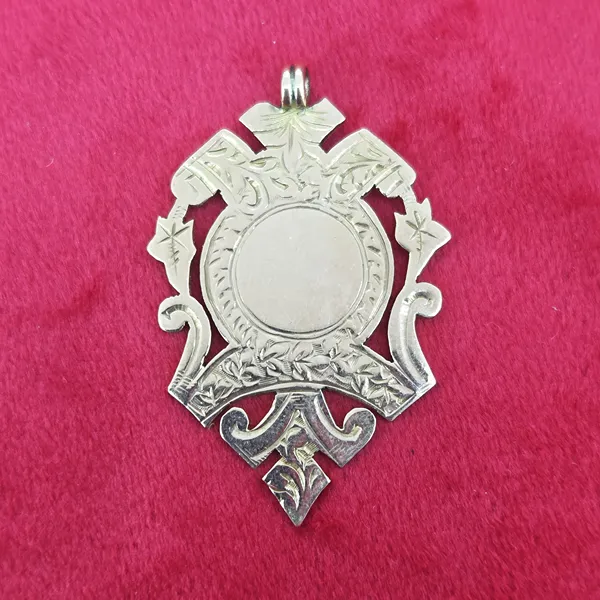
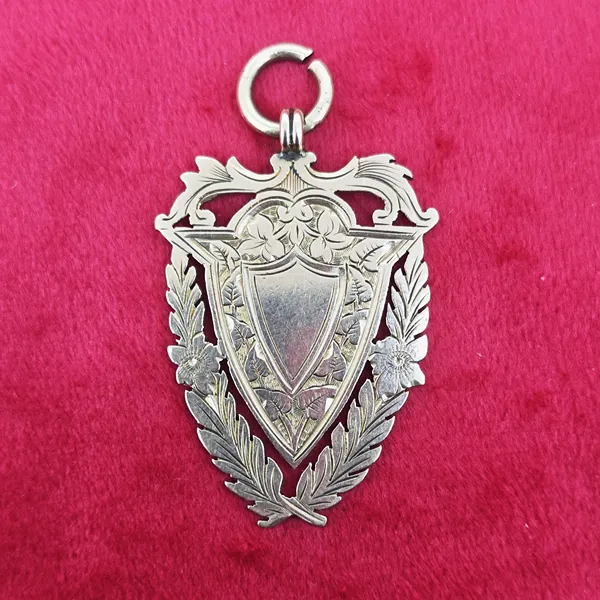
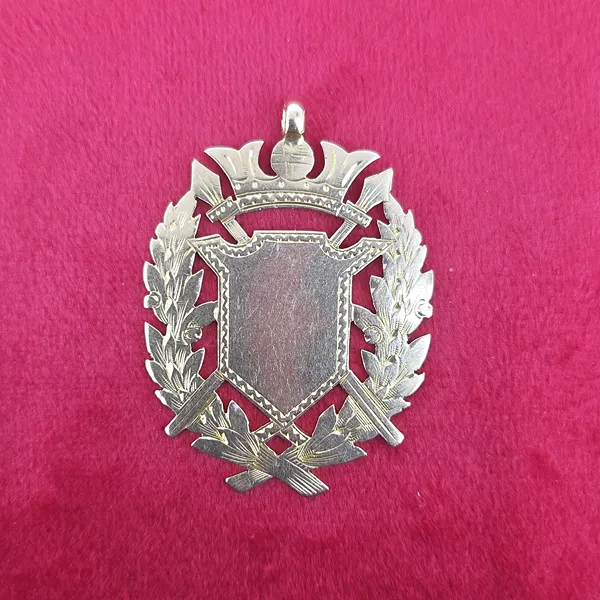
Some are circular and beautifully restrained. Others take the form of shields, stars and more elaborate shapes. Some are richly engraved, while others feature decorative borders, crests, initials or motifs.
Your new De Bruns collection demonstrates this diversity particularly well. It includes, amongst other pieces, an 1899 Victorian 9ct Gold Star Medal by Joseph Adelman, a 1908 9ct Gold Medal by William Light, a 1918 Shield Medal by James Walter Tiptaft, and a 1920 15ct Gold Medal by John Grinsell & Sons.
It is this variety that makes collecting and wearing them so interesting.
Why Were Gold Medals Made?
Today, the word "medal" can make us think immediately of sporting or military achievement, but historically the category was considerably broader.
Prize and presentation medals could be commissioned to recognise a particular achievement or association. Others were created to commemorate events or membership.
Gold made these objects more than simple tokens. They were intended to be valued and retained and that is an important distinction when looking at them as Antique jewellery today.
These weren't necessarily objects designed to spend their lives hidden in a box. Many were created with suspension loops so they could be hung from a chain. Your collection page itself notes that many gold medals were designed to hang in precisely this way.
More than a century later, that original functionality makes them remarkably easy to incorporate into a modern jewellery collection.
The Golden Age of the Presentation Medal
The late Victorian and Edwardian periods produced some particularly beautiful examples.
Jewellery and decorative objects of this era were often highly detailed, and medals gave makers a relatively small surface on which to demonstrate considerable skill. Turn one over and the reverse can be just as interesting as the front.
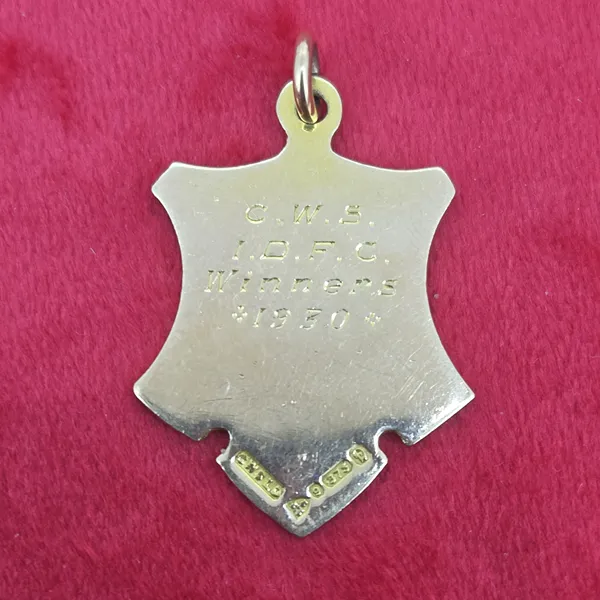
Engraving might record a recipient, date or achievement. Hallmarks can potentially tell us where and when a gold example was assayed. A maker's mark can lead us towards the workshop or company responsible for producing it.
Sometimes the appeal is immediately obvious from the front; other times the most interesting element is hidden on the reverse. This is one reason we encourage people to look at antique medals as three-dimensional objects rather than simply pendants. Every surface can potentially reveal something.
Hallmarks: The Tiny Details We Always Look For
Anyone familiar with De Bruns will know how much we love a good hallmark.
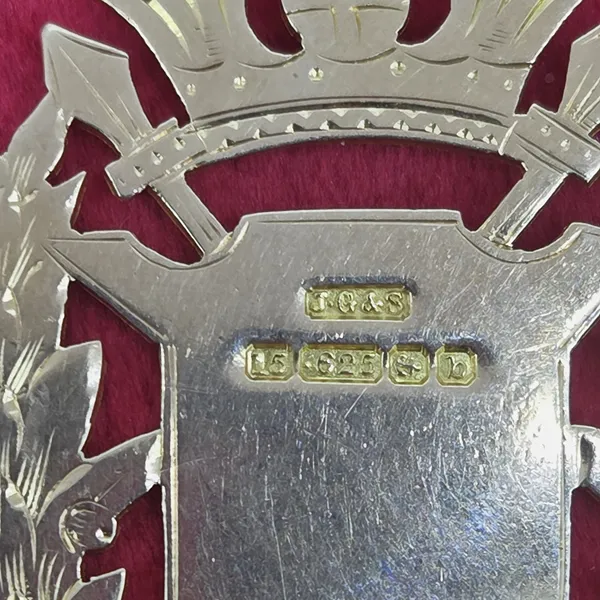
On antique British Gold pieces, hallmarks can be an invaluable part of understanding what you have in front of you. Depending on the piece and period, a set of marks can provide information about the precious-metal standard, assay office and date, while a sponsor's or maker's mark can offer another avenue of research. For us, that research is part of the enjoyment.
It can turn an attractive old gold object into something far more tangible. Suddenly, rather than simply having "an old medal", you can begin placing it within a particular period and manufacturing tradition.
Our new collection includes examples attributed to several named makers and manufacturers, and the category itself spans both 9ct and 15ct Gold examples. The 1920 John Grinsell & Sons piece, for example, is listed as a 15ct Gold Antique Medal.
That level of detail is precisely what we look for when handling Antique Gold.
The Engraving Is Part of the Charm
With many types of jewellery, buyers can instinctively think that an inscription belonging to somebody else somehow makes a piece less relevant to them.
With antique medals, we'd argue almost the opposite. An original engraving can be one of the most charming aspects of the piece. A name you don't recognise, initials that aren't yours or a date from more than a century ago are reminders that the medal existed before you did. They aren't necessarily something that needs explaining away. They are part of its character.
We particularly love dates. A crisply engraved 1899, 1908, 1918 or 1920 immediately anchors an object in time. Our collection includes all of these years, alongside later examples such as medals dated 1926, 1927 and 1929.
For lovers of old things, that is part of the magic.
From Medal to Jewellery: Why They Look So Good Today
This is where antique medals become particularly exciting for us.
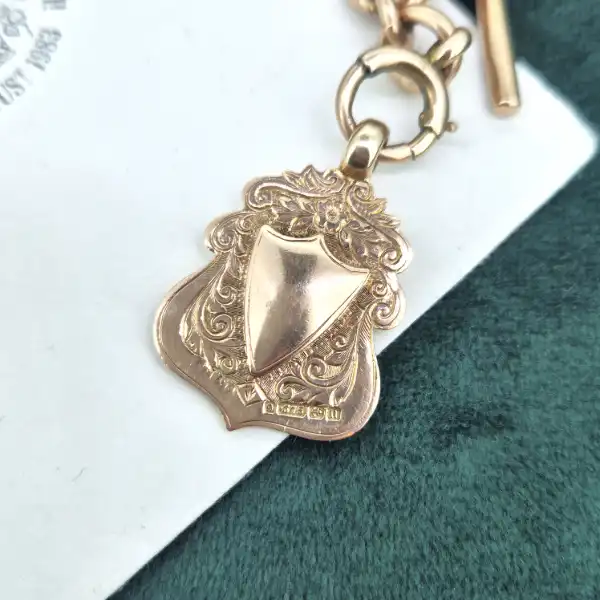
They are incredibly wearable. Many were made with suspension loops, meaning they lend themselves naturally to being hung from a chain. And, of course, our favourite way to wear one has to be with an antique Albert chain.
Originally associated with watch chains, Alberts have become one of the most versatile forms of antique gold jewellery. The T-bars, swivels, dog clips and bolt rings found on different examples make them particularly suited to attaching fobs, pendants and medals. There is something wonderfully satisfying about bringing two antique objects together in this way.
A beautifully engraved gold medal hanging from a substantial 9ct or 18ct Albert chain looks intentional, individual and completely different from a conventional modern necklace.
Better still, you can change it. You could wear the Albert alone one day, add a single medal the next, or build a small collection of antique fobs and charms for a fuller look.
Wearing an Antique Medal as a Pendant
You certainly don't need an Albert chain to wear one.
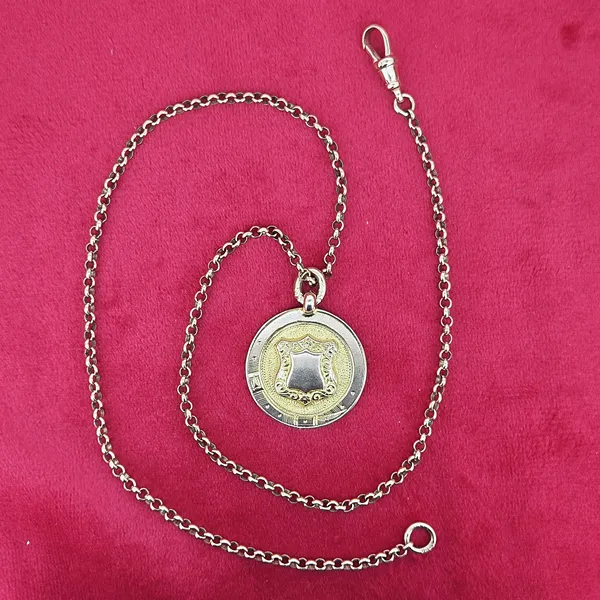
A single antique medal suspended from a simple gold chain can look incredibly elegant. In fact, the contrast can work beautifully: an intricately engraved Victorian or Edwardian medal paired with a relatively simple chain allows the medal itself to become the focal point.
For a more layered look, try combining different chain lengths and textures. We particularly like antique medals worn alongside other old gold pieces rather than attempting to make everything perfectly match. Different ages, shades of gold and link styles can create a much more interesting collection.
That is the joy of antique jewellery. It doesn't need to be uniformed.
Shield, Star or Traditional Round Medal?
Shape can completely change the character of a medal.
A traditional circular example has the immediate recognisability of a medal and works particularly well as a standalone pendant.
Shield-shaped medals have a stronger silhouette and can look fabulous hanging from the centre of an Albert.
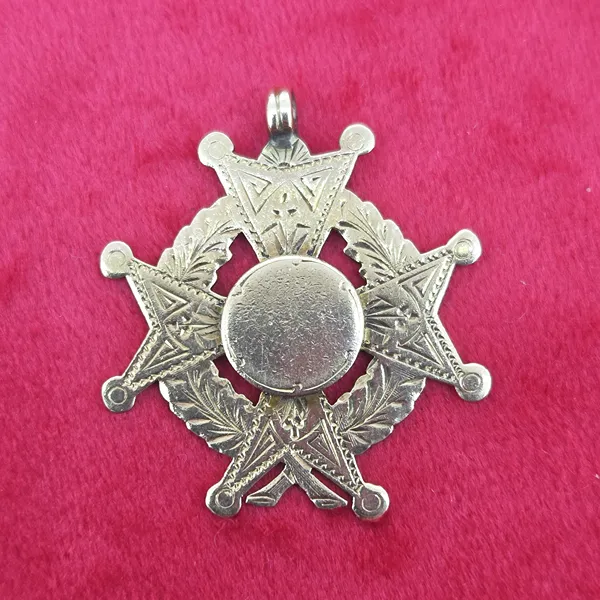
Star-shaped medals offer something more decorative again. Our collection includes an 1899 Victorian 9ct Gold Star Medal by Joseph Adelman, giving a lovely example of just how far medal design could move beyond the conventional circle. There are also scroll-topped and reversible examples within the collection, adding further variety.
We wouldn't necessarily choose by shape alone. Often it is a combination of the outline, engraving, age, maker and overall feel that makes one particular medal stand out.
9ct and 15ct Antique Gold Medals
One of the pleasures of British Antique Gold Jewellery is encountering gold standards that reflect their period. 9ct Gold features strongly throughout our medal collection, as it does across much of the Antique Gold jewellery we specialise in. But you will also find 15ct Gold.
For those relatively new to antique jewellery, 15ct Gold is an interesting historical standard and appears in many beautiful Victorian and early 20th-Century pieces. Our collection includes a dated 1920 15ct Gold medal by John Grinsell & Sons.
For us, these details are another reason antique jewellery is so compelling. You're not simply choosing between designs. You're encountering different makers, manufacturing techniques, gold standards and periods of jewellery history.
What Should You Look for When Choosing an Antique Medal?
There isn't one characteristic that makes the "best" antique medal. We look at the piece as a whole.
Condition matters, certainly, but so does character. We consider the quality of the workmanship, the definition of decorative details, the engraving, the hallmarks where present and whether the medal has an appealing overall design.
Wear is not automatically a negative. These pieces are old. Gentle signs of age can be entirely appropriate and can contribute to their character.
For someone intending to wear a medal, we'd also think about its size, weight, suspension and how it will sit on the chosen chain.
Most importantly, choose the one you keep coming back to.
An Antique Medal Makes a Very Different Kind of Gift
There is also something rather special about giving an antique medal. For someone who already owns plenty of conventional jewellery, it is refreshingly unexpected. You might choose one because of a significant date, an initial, a particular shape or simply because its design reminds you of the recipient.
It could mark a birthday, graduation, professional achievement or personal milestone. It could be a modern celebration represented by an object originally created to celebrate achievement in another era. There is something rather lovely about that continuity.
Why Antique Medals Belong at De Bruns
Antique Medals feel like a very natural addition to the De Bruns collection. We've spent more than 17 years in the jewellery business, with Antique Gold at the heart of what we love. Our Albert chains and bracelets are among the pieces for which we're best known, so finding exceptional antique objects to complement them makes perfect sense.
The new collection currently brings together 18 (at the time of writing this article) Antique Gold Medals, selected around the qualities that matter to us: craftsmanship, condition, character and individuality. The collection page itself describes them as Victorian and Edwardian prize, presentation and commemorative examples from the late 1800s and early 1900s.
Our business may be online, but our service is extremely personal. After 17 years, we know that the details matter, particularly when someone is choosing an antique piece they may never encounter again.
A Second Life for a Piece of History
Perhaps that is ultimately what we love most about Antique Medals.
They weren't made yesterday to imitate the past. They are the past.
The marks, dates, engraving and tiny signs of age are all part of what makes each one individual. Yet despite their history, they don't need to become museum pieces.
Add one to an Albert chain and suddenly an object created more than a century ago becomes part of your everyday jewellery.
Wear it alone as a pendant and it takes on an entirely new personality.
Combine several old pieces and you begin creating a collection that is uniquely yours.
Antique medals sit at the meeting point of history and fine jewellery and we think they deserve to be worn, enjoyed and admired all over again.